The Echo War room
Fall 2025 | VIS 2484 Interdisciplinary Art and Design Practices | Instructor: Malkit Shoshan
Gina Wenxuan Qiao and VN Chen
When Empathy Collapses into Errors
The (war)room is a non–site-specific installation that invites audiences into an uncanny black box—an isolated chamber where they enter a conversation with characters modeled on Dr. Strangelove. The space echoes the iconic circular table of the war room in the film: an arena of strategic performance, projected rationality, and imminent collapse. Here, the tension is immediate. The scenario unfolds as the bombers approach Soviet territory, nearing the point at which the “Doomsday Machine” becomes irreversible. Seated at the table, the audience must reason with an AI version of figures such as General Turgidson—arrogant, paranoid, and almost impossible to reach. The conversation is designed, most likely, to fail. It will loop, distort, or glitch, revealing the system’s inability to really listen. This breakdown is not a bug; it is the core of what the project explores as dark matter.
Dark matter, in this installation, refers to the invisible violence embedded in human communication—those systemic misunderstandings that accumulate across history and quietly steer destructive outcomes. One example is the 1945 mokusatsu incident. When Japan responded to the Potsdam Declaration with the term mokusatsu, the US government heard “unconditional rejection,” and Japan appeared even more unready to surrender. Some historians suggest that this misunderstanding precipitated the atomic bomb. Other accidents of communicative opacity transpired during the Manhattan Project. Secrecy, combined with bureaucratic silence, left thousands of residents vulnerable to noxious fallout. Incidents like these reveal that miscommunication is no human foible: it’s a historical agent.
Nuclear crisis operates at the scale Timothy Morton describes as the hyperobject (2018): phenomena so vast, temporally and spatially, that they exceed human comprehension. Radiation, climate change, planetary war, all these forces are “physically huge but ontologically tiny,” diffuse yet overwhelming. Morton argues that hyperobjects cannot be solved or even fully observed; one must “undergo them.” They are present, pressing, and often invisible—much like the communicative violence that structures political decision-making. To dissolve this conceptual dark matter, what is required is not more information but transformed modes of communication—speech grounded in empathy and care. An effective communication is about situating oneself within systems of procedural and structural violence. It is precisely where empathy collapses into error that the need for new forms of relational awareness emerges.
(War)room also functions as a critique of what Ignacio Ramonet once called tittytainment: a global apparatus of distraction, comfort, and pacification delivered through digital overstimulation. In today’s virtual landscape, infinite scroll replaces the streets and the squares. As Scott Galloway (2001) notes, men aged 20-30 now spend less time outdoors than prison inmates. The Doomsday Clock is ticking-tocking closer to twelve, but TikTok's algorithm rarely pushes related news to its users. The installation creates a heterotopia within this overstimulated environment—a tear in the digital fabric, a room where the audience must confront voices and logics rarely encountered within algorithmic bubbles. It becomes a space where people meet what they would otherwise scroll past.
As Donna Haraway writes (1988), situatedness is about being accountable within the web of relations that constitute us. The (war)room does not offer redemption or catharsis; rather, it offers a place to linger in uncertainty—to argue, reflect, and sense what it means to live when the world itself feels like it is glitching.
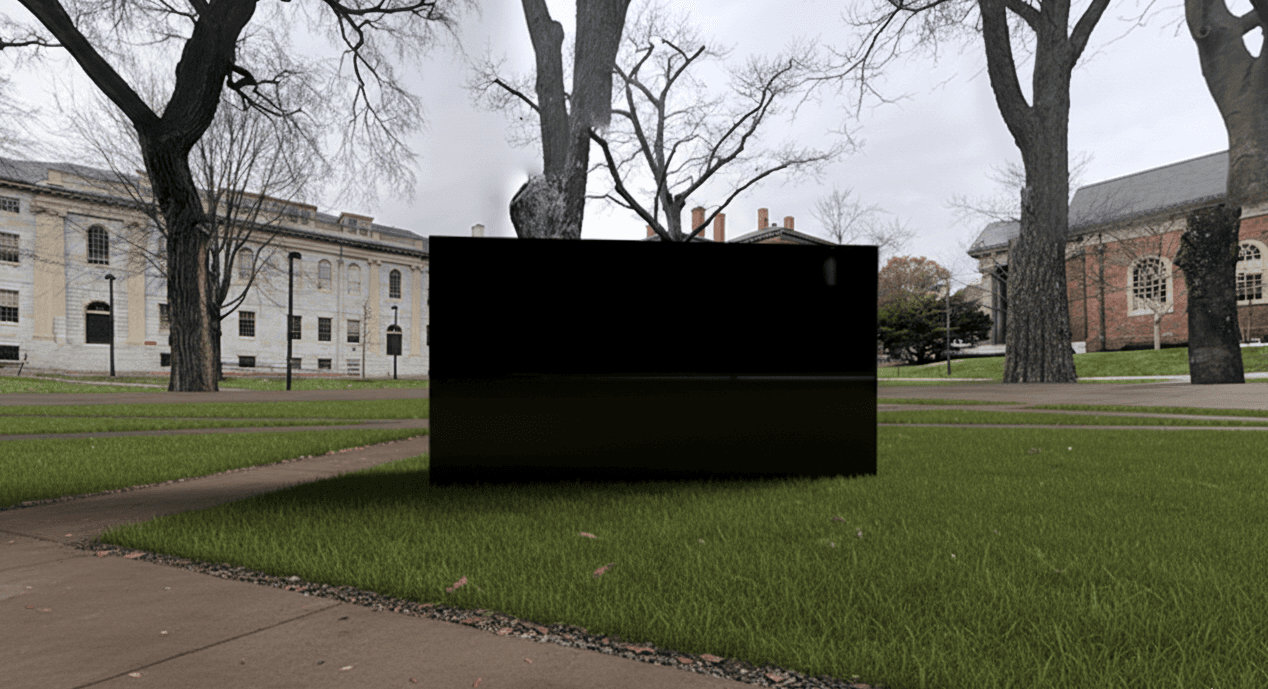
The installation’s physical structure references the War Room’s round table, although the circle is an illusion. A narrow one-sixteenth arc, reflected in mirrors, becomes a monumental loop. Its heterogeneity is further emphasized in its exterior form—a pure black rectangular monolith reminiscent of the one in Kubrick’s 2001: A Space Odyssey. In the film, the monolith is a mysterious, geometrically perfect black structure that symbolizes a force or intelligence beyond human comprehension. It appears repeatedly as a trigger for shifts in consciousness, technological evolution, and perceptual transformation, its meaning intentionally left open and unexplained.
Because improvised speech can be challenging—especially for those unfamiliar with the film—a small booklet on Nonviolent Communication is offered as a practical guide, outlining four steps: observe, identify feelings, express needs, and make a request. Yet even with this tool, the dialogue is still more likely to loop or collapse. The room is a glitch zone, heterogeneous to everyday life. The malfunction is aesthetic, conceptual, and emotional: lights flicker when the conversation takes an unexpected turn; text distorts; and at the end of each session, the audience receives a small printed receipt—a fragmentary trace of the glitched encounter.
But the glitch receipt is not the end. The mirrored table reflects both the room and the participants themselves. Their attempt to persuade an unpersuadable machine becomes a confrontation with their own assumptions, projections, and phantoms. Who are they really speaking to? The mirror’s function is not decorative but conceptual: it reconfigures the relationship between subject and interlocutor.
Lacan’s theory of the mirror stage proposes that the subject is not naturally formed but constructed through a childhood misrecognition in the image and language of the Other. Within this dialogical space, the Other’s image and echo become the audience’s own reflection. Who am I? Who is the interlocutor? In a Buddhist context, another answer emerges: “All that have form are illusory.” From sound to bodily presence, what we perceive is shaped by what we think. This is not a negation of physical reality; rather, it acknowledges, in practical terms, the interlocutor’s agency—the capacity to alter the outcome of the dialogue.
Enclosing the space intensifies this dynamic. (War)room becomes a kind of camera obscura, intensifying the dialectical relationship between subject and object: as observers inside the dark chamber, what is their relationship to the world outside? How might the conversations within this installation resonate beyond its walls? What insights might it offer to contemporary nuclear discourse? And how might current conflicts influence the dialogues that unfold inside?
The installation does not aim to solve the nuclear problem or offer policy solutions. Instead, it creates a space where communication—its failures, distortions, and potentials—becomes a lived experience. In this sense, (war)room is less a simulation of the War Room and more a rehearsal for living inside hyperobjects: a training ground for confronting the vast, invisible forces that shape our shared future.
Citation
Laura Copelin, et al. Hyperobjects for Artists. Ballroom Marfa, 2018.
Haraway, Donna. “Situated Knowledges: The Science Question in Feminism and the Privilege of Partial Perspective.” Feminist Studies, vol. 14, no. 3, 1988, pp. 575–99, https://doi.org/10.2307/3178066.
Galloway, Scott. “Notes on Being a Man.” The Week (New York, N.Y. 2001), Zinio, LLC, 2025, p. 22.